Tuesday, February 28, 2006

News From Vatican Information Services 02/28/2006


SUMMARY:

- Gypsies: Pastoral Action in Appreciation of their Culture
- Spiritual Exercises of Pope and Roman Curia
- Other Pontifical Acts

___________________________________________________________

GYPSIES: PASTORAL ACTION IN APPRECIATION OF THEIR CULTURE

VATICAN CITY, FEB 28, 2006 (VIS) - This morning in the Holy See Press Office, Cardinal Stephen Fumio Hamao and Archbishop Agostino Marchetto, respectively president and secretary of the Pontifical Council for the Pastoral Care of Migrants and Itinerant Peoples presented the document: "Guidelines for the Pastoral Care of Gypsies."

The text of the document is the result of a broad-ranging study to which pastoral workers, experts and gypsies themselves have all contributed. The document's six chapters are divided into two sections: the first presents an overall view of the Church and gypsies, while the second concentrates on specific questions.

Cardinal Hamao explained how the origins of a specific form of pastoral care for gypsies date back to the first half of the 20th century "through the individual initiatives of some zealous priests in France, Germany, Italy and Spain. The Holy See recognized it as a special mission in 1965, after the first historic international pilgrimage of gypsies to Rome, by creating the International Secretariat for the Apostolate of Nomads," which was later integrated into the Pontifical Commission for the Pastoral Care of Migration and Tourism, created by Paul VI in 1970.

"Though the document refers to gypsies, whose number in Europe alone is about 15 million," the cardinal continued, "it is equally valid for other nomads, who share similar conditions of life in the various continents. In any case, nomadism is not the only characteristic of the gypsy people. ... It is their ethnicity, their culture and age-old traditions that we should take into account. Therefore the local Churches, in countries where they live, should find pastoral inspiration in these Guidelines, ... adapting them to the circumstances, needs and requirements of each group."

The president of the pontifical council went on to note certain "positive signs of evolution" among gypsies, such as "a growing desire to attain literacy and professional formation, social and political awareness expressed by forming associations and parties, increasing participation in local and national management in some countries, and the presence of women in social and civic life." He also recalled the enthusiastic participation of gypsies at "the beatification of the Spanish martyr Ceferino Jimenez Malla, the first gypsy to be raised to the honor of the altar."

Although the nomadic quality of gypsy life in some way reflects the condition of all mankind - "homo viator" - gypsies' right to identity often comes up against the "indifference or opposition" of many people, who "share habitual prejudices towards them. Signs of rejection persist, often without eliciting any reaction or protest from those who witness them."

The cardinal added: "All this has caused untold suffering in the course of history, as we know. Their persecution reached its height especially during the past century. ... Obviously the Church too should recognize their right to have their own identity, and stir consciences in order to achieve greater justice for them."

Returning to the subject of nomadism, Cardinal Hamao noted how this form of life "has given rise to an identity with its own languages, and a culture and religiosity with its own traditions, and a strong sense of belonging. ... Their way of life is essentially a living witness to inner freedom from the bonds of consumerism and of the false security based on people's presumed self-sufficiency."

"These Guidelines," he concluded, "are a sign that the Church has a particular concern for gypsies, meaning that they are the receiver of a special pastoral action in appreciation of their culture. ... In fact, everyone should be welcomed in the Church, where there is no place for marginalization and exclusion."

For his part, Archbishop Marchetto concentrated on pastoral activity, firstly noting that "the peculiar nature of gypsy culture makes evangelization merely 'from the outside' ineffective." All the same, "a genuine incarnation of the Gospel - called inculturation - cannot indiscriminately legitimize every aspect of their culture."

He continued: "Indeed, the universal history of evangelization affirms that the spread of the Christian message has always been accompanied by a process of purification of cultures. ... However, purification does not mean emptying, but some amount of integration with the surrounding culture will be necessary: it is an intercultural process. Reconciliation and communion between gypsies and non-gypsies, therefore, include legitimate interaction between cultures."

The archbishop praised the "strong sense of family which is seen among gypsies," but warned that this "should not degenerate, for instance, into perennial resentment between families and clans." He also recalled the need among gypsies for equal rights between men and women and stressed the fact that "honesty at work is a civic and Christian virtue, which cannot be disregarded." He also lamented the fact that "audiovisual or printed information rarely makes the general public aware of the positive aspects of gypsy culture, and most often deals with negative ones, which further damage their image."

"Of course, gypsies are a special minority because they have no country of origin to give them the support they might need and this means the lack of political guarantees and some degree of civil protection. In fact while the arrival of other people seeking refuge and of 'boat people' enables mobilization of a given number of people and governments, that of gypsies usually brings about rejection, even if they come from very poor countries, and are sometimes forced to flee due to religious, racial or political persecution."

Archbishop Marchetto pointed out that this situation can only be overcome with a common and comprehensive global policy, and that "it is vitally important that international organizations take an interest in gypsies."

On the subject of the evangelization of gypsies, he said it "is a mission of the whole Church, because no Christian should remain indifferent to a situation of marginalization with respect to ecclesial communion. ... Moreover, in the catechesis, it is important to include dialogue that allows gypsies to express how they perceive and experience their relationship with God. Therefore, it is necessary to assess the convenience of translating the Bible, the various liturgical texts and prayer books, into the languages used by the different ethnic groups."

The secretary of the Pontifical Council for Migrants and Migrant Peoples concluded by highlighting the danger of the proselytism of religious sects among gypsies and indicating how "new ecclesial movements could play a special role in this specific pastoral care. With their strong sense of community and openness, and the availability and special warm-heartedness of their members."

The complete document, will soon be available for consultation on the web page of the Pontifical Council for Migrants and Itinerant Peoples.

CON-SM/PASTORAL GYPSIES/HAMAO:MARCHETTO VIS 060228 (1120)

OTHER PONTIFICAL ACTS

VATICAN CITY, FEB 28, 2006 (VIS) - The Holy Father:

- Accepted the resignation from the pastoral care of the archdiocese of Galveston-Houston, U.S.A., presented by Archbishop Joseph Anthony Fiorenza, upon having reached the age limit. He is succeeded by Coadjutor Archbishop Daniel N. DiNardo.

- Gave his assent to the canonical election carried out on February 9 by the Synod of Bishops of the Greek-Melkite Catholic Church meeting in Ain Traz, Lebanon, from February 6 to 11, 2006, of Archimandrite Georges Bakar, bursar of the Patriarchate of Alexandria, as patriarchal vicar of Jerusalem with the title of archbishop of Pelusio of the Greek-Melkite Catholics. The archbishop-elect was born in Cairo, Egypt, in 1946 and ordained a priest in 1973.

His Beatitude Gregoire III Laham, Greek-Melkite Catholic patriarch, with the consent of the synod of the patriarchal Church meeting in Ain Traz, Lebanon, from February 6 to 11, 2006, transferred, in accordance with canon 85 para. 3 of the Code of Canons of the Eastern Churches, Bishop Isidore Battikha B. A., auxiliary and "protosincellus" of Damascus of the Greek-Melkites, to the position of metropolitan archbishop of Homs, Hama and Jabrud (Catholics 27,000, priests 14, permanent deacons 1, religious 33), Syria.
RE:NER/.../... VIS 060228 (210)
V.I.S. -Vatican Information Service.
Copyright © Vatican Information Service 00120 Vatican City


Monday, February 27, 2006

News From Vatican Information Services 02/25-27/2006


SUMMARY: FEBRUARY 25 - 27

- Peter's Pence: Communion with Pope and Attention to Needs
- Thanks to Rome's Municipal Police for their Service
- Archbishop Tomasi Addresses Question of Maritime Work
- Saint Joseph, Encouragement on the Path to the Priesthood
- Other Pontifical Acts
- Approach Lent with a New Spirit
- God Will Call to Account Those Who Spill Blood in His Name
- Each Human Being Is a Reflection of Divine Reality
- Greek Orthodox: Together Let Us Affirm Christian Values
- Message for Twenty-First World Youth Day
- Audiences

___________________________________________________________

PETER'S PENCE: COMMUNION WITH POPE AND ATTENTION TO NEEDS

VATICAN CITY, FEB 25, 2006 (VIS) - This morning the Pope received members of the Rome-based charity organization Circle of St. Peter, for their traditional annual audience during which they present him with Peter's Pence, the proceeds of collections taken up in Roman churches over the last year.

"This is a gesture," said the Holy Father, "with a value that is not only practical but also strongly symbolic, as a sign of communion with the Pope and of attention to the needs of our brothers and sisters. For this reason, your service has a uniquely ecclesial value."

After recalling how the second part of his recent Encyclical "Deus caritas est" is dedicated to the practice of charity by the Church, "as a community of love," Benedict XVI told his listeners that the same document traces outlines that could prove useful to people like them, who collaborate in "the ministry of charity of the Christian community."

"I recalled," he continued, still referring to the Encyclical, "that the principle motivation for action must always be the love of Christ; that charity is more than a simple activity and implies the giving of self; that this gift must be humble and removed from all feelings of superiority; and that its strength comes from prayer, as the example of the saints shows."

The Pope concluded his address by entrusting the members of the Circle of St. Peter "to the saints of charity, of whom, beginning with Deacon Lawrence, the history of the Church of Rome is so rich."
AC/.../CIRCLE ST. PETER VIS 060227 (270)

THANKS TO ROME'S MUNICIPAL POLICE FOR THEIR SERVICE

VATICAN CITY, FEB 25, 2006 (VIS) - This morning in the Clementine Hall, Benedict XVI met with members of the 17th Group of the Roman Municipal Police, whose job it is to control traffic on streets near the Vatican.

The Pope thanked them for their daily service, which "calls for constant commitment because the area around the Vatican is frequented by many people and the traffic is intense."

The police officers carry out their work with "professional commitment and dedication" said the Pope, highlighting how they had particularly demonstrated these qualities during the period of the sickness, death and funeral of John Paul II, and "on the occasion of my election as Supreme Pontiff in April last year."

Benedict XVI expressed the hope that the proximity of the tomb of St. Peter and the chance to participate in meetings between the Pope and the faithful, or in liturgical celebrations in St. Peter's Square, may help them "to grow spiritually and to feel the presence of Christ beside you. With His help, you will be able to carry out your activities serenely, in the awareness that you are rendering a service to the community."
AC/.../ROME MUNICIPAL POLICE VIS 060227 (210)

ARCHBISHOP TOMASI ADDRESSES QUESTION OF MARITIME WORK

VATICAN CITY, FEB 25, 2006 (VIS) - Archbishop Silvano M. Tomasi C.S., Holy See permanent observer to the United Nations at Geneva, spoke on February 20 at the 94th session of the International Labor Conference (Maritime).

During the session, which was held in Geneva from February 7 to 23, a convention on maritime work was approved, coordinating and updating the provisions of more than 60 earlier international instruments.

Archbishop Tomasi expressed the hope that the conference would "provide 'opportunities for women and men to obtain decent and productive work, in conditions of freedom, equity, security and human dignity,' as the Report of the Director General has stated."

The permanent observer called on States to ratify the Consolidated Maritime Labor Convention which, if "implemented effectively at the national level, will bring great benefits to the lives of millions of people over time, and be an example of good practice to the whole industrialized world."
DELSS/MARITIME CONVENTION/TOMASI VIS 060225 (170)

SAINT JOSEPH, ENCOURAGEMENT ON THE PATH TO THE PRIESTHOOD

VATICAN CITY, FEB 25, 2006 (VIS) - In keeping with an annual tradition of his predecessor John Paul II, this afternoon Benedict XVI visited the major seminary of Rome, on the occasion of the feast of its patroness, Our Lady of Trust.

After listening to a musical composition dedicated to St. Joseph and entitled "Shadow of the Father," the Pope highlighted how the example of this "'just man,' fully responsible before God and before Mary, provides encouragement for everyone on the path to the priesthood. We see him ever-attentive to the voice of the Lord Who guides the events of history, ready to follow His guidance; always faithful, generous and impassive in his service, an effective master of prayer and work in the obscurity of Nazareth.

"I can assure you," the Pope continued in his address to the seminarians, "that the more you progress, with the grace of God, along the path of the priesthood, the more you will experience the rich spiritual fruits [to be gained] by referring to St. Joseph and invoking his support when carrying out your daily duties."

The Holy Father then expressed the hope that the seminarians "learn to repeat the beautiful invocation 'Mater mea, fiducia mea'" of his "venerated predecessor" Benedict XV. "May these words remain impressed on the hearts of each of you and accompany you always during your lives and your priestly ministry. Thus, wherever you may be, you will be able to propagate the fragrance of Mary's own trust, which is trust in the provident and faithful love of God."

The Pope told the seminarians that on his arrival in the seminary he had prayed in the chapel for each of them, and that his thoughts had also gone out to "the many seminarians who have passed through the Roman seminary and who have served with love the Church of Christ. I am thinking, among others, of Fr. Andrea Santoro who was murdered recently in Turkey, as he was praying."

"I also invoked the Mother of the Redeemer, that she may obtain the gift of sanctity for you also. May the Holy Spirit Who formed the priestly Heart of Jesus in the Virgin's womb and then in the house of Nazareth, work in each of you with His grace, preparing you for the future tasks that will be entrusted to you."
BXVI-VISIT/.../ROME MAJOR SEMINARY VIS 060227 (410)

OTHER PONTIFICAL ACTS

VATICAN CITY, FEB 25, 2006 (VIS) - The Holy Father:

- Appointed Fr. Robert Patrick Ellison C.S.Sp., secretary general of the Congregation of the Holy Ghost, as bishop of Banjul (area 10,403, population 1,639,500, Catholics 34,000, priests 26, religious 42), Gambia. The bishop-elect was born in Dublin, Ireland in 1942 and ordained a priest in 1969. He succeeds Bishop Michael J. Cleary C.S.Sp., whose resignation from the pastoral care of the same diocese, the Holy Father accepted, upon having reached the age limit.

- Appointed Archbishop Fernando Filoni, apostolic nuncio to Iraq and Jordan, as apostolic nuncio to the Philippines.

- Appointed Cardinal Nicolas de Jesus Lopez Rodriguez, archbishop of Santo Domingo, Dominican Republic, as his special envoy to celebrations marking the fourth centenary of the death of St. Toribio de Mogrovejo, patron saint of the Latin American episcopate. The celebrations are due to be held in Lima, Peru, from April 24 to 29.

- Appointed Msgrs. Pier Enrico Stefanetti, Stefano Sanchirico and Diego Giovanni Ravelli, as pontifical masters of ceremonies.
NER:RE:NN:NA/.../... VIS 060227 (180)

APPROACH LENT WITH A NEW SPIRIT

VATICAN CITY, FEB 26, 2006 (VIS) - At midday today, the Pope appeared at the window of his study overlooking St. Peter's Square to pray the Angelus with thousands of pilgrims gathered below.

In comments before the Marian prayer, Benedict XVI spoke of the forthcoming period of Lent, recalling how the Gospel of St. Mark, "offers a catechumenal itinerary guiding the disciple to recognize in Jesus the Son of God.

"By a happy coincidence," he explained, "today's Gospel text touches on the subject of fasting. ... As Jesus was sitting at table in the house of Levi the publican, the Pharisees and the followers of John the Baptist asked Him why His disciples were not fasting like them. Jesus replied that the wedding guests cannot fast while the bridegroom is with them; when the bridegroom is taken from them, then they will fast.

"With these words, Christ reveals His identity as the Messiah, Bridegroom of Israel, Who has come for the wedding with His people. Those who recognize Him and welcome Him with faith celebrate. However, He must be rejected and killed by His own people: at that moment, during His passion and His death, will come the time of mourning and fasting."

This evangelical episode, anticipating the significance of Lent, "constitutes a great memorial of the Lord's passion, in preparation for the Easter of Resurrection. ... The period of Lent must not be approached with an 'old' spirit, as if it were a heavy and troublesome burden, but with the new spirit of one has found in Jesus and in His mystery the meaning of life, and is aware that everything must now refer to Him."

"On our Lenten journey, may our guide and teacher be Most Holy Mary who, when Jesus set out for Jerusalem to suffer His passion, followed Him with total faith. Like a 'new wineskin,' she received the 'new wine' brought by the Son for the messianic wedding."
ANG/LENT/... VIS 060227 (330)

GOD WILL CALL TO ACCOUNT THOSE WHO SPILL BLOOD IN HIS NAME

VATICAN CITY, FEB 26, 2006 (VIS) - After praying the Angelus at midday today, the Pope addressed further remarks to pilgrims gathered in St. Peter's Square, in which he touched on certain events of the last few weeks.

"News is still arriving over these days," said the Holy Father, "of tragic violence in Iraq, with attacks even directed against mosques. These acts spread mourning, nourish hatred and impede the already difficult job of reconstructing the country."

He went on to refer to Nigeria where "clashes between Christians and Muslims have continued for several days, with many victims and the destruction of churches and mosques. While expressing my firm condemnation for the violation of places of worship, I entrust to the Lord all the dead and those who weep for them.

"I also invite everyone to intense prayer and penance in the sacred period of Lent, that the Lord may free those dear nations, and so many other places on the earth, from the threat of such conflicts."

"The fruit of faith in God," the Pope concluded, "is not devastating rivalry but the spirit of brotherhood and of collaboration for the common good. God, Creator and Father of everyone, will call more severely to account those who spill their brothers' blood in His name. By the intercession of the Blessed Virgin, may everyone rediscover themselves in Him Who is true peace!"
ANG/IRAQ:NIGERIA:CONFLICT/... VIS 060227 (250)

EACH HUMAN BEING IS A REFLECTION OF DIVINE REALITY

VATICAN CITY, FEB 27, 2006 (VIS) - Benedict XVI today received participants in the general assembly of the Pontifical Academy for Life which is currently considering the theme of "the human embryo prior to implantation."

The Pope described the theme as "fascinating, but difficult and arduous given the delicate nature of the subject being examined and the complexity of epistemological problems concerning the relationship" between experimental scientific data and reflection on anthropological values.

After recalling that Holy Scripture "expresses the love of God towards all human beings even before they take form in the mother's womb," the Holy Father affirmed: "The love of God does not distinguish between the newly-conceived infant still in its mother's womb, the baby, the youth, the grown adult or the elderly, because in each of them He sees the sign of His own image and likeness."

"This limitless and almost incomprehensible love of God for man reveals to what point human beings are worthy of love in themselves, regardless of any other consideration, be it intelligence, beauty, health, youth, integrity and so on. Human life is a good thing, always and definitively."

Benedict XVI went on to make it clear that "in man, in all men and women, whatever their stage or condition of life, there shines a reflection of God's own reality. For this reason, the Magisterium of the Church has constantly proclaimed the sacred and inviolable nature of each human life, from conception to natural end. This moral judgement also holds at the beginning of an embryo's life, even before it is implanted in the mother's womb."

Referring to research into the origins of life, "a mystery which science will be able to illuminate ever more clearly, though with difficulty will it decipher it altogether," the Pope indicated that "those who love truth must be aware that research into such profound themes puts us in the position of seeing and almost touching the hand of God. Beyond the limits of experimental methods, at the confines of the area that some call meta-analysis, where sensorial perception and scientific tests are neither enough or even possible, that is where the adventure of transcendence begins."
AC/HUMAN EMBRYO/... VIS 060227 (370)

GREEK ORTHODOX: TOGETHER LET US AFFIRM CHRISTIAN VALUES

VATICAN CITY, FEB 27, 2006 (VIS) - At midday today, the Pope received a group of students - priests and seminarians - from the Theological College of "Apostoliki Diakonia" of the Orthodox Church of Greece, who are currently visiting Rome.

In a Message consigned to them at the end of their audience with him, the Holy Father writes: "For we Christians of both East and West, at the beginning of the second millennium the forces of evil acted in the divisions that still persist between us today. Nonetheless, over the last 40 years many consoling and hopeful signs have caused us to see a new dawn, that of the day on which we will fully understand that being rooted and founded in Christ's charity means truly finding a way to overcome our divisions through personal and community conversion, listening to others and common prayer for our unity."

Benedict XVI identifies one of these hopeful signs in the positive development of relations between the Church of Rome and the Greek Orthodox Church. The meeting between John Paul II and His Beatitude Christodoulos, archbishop of Athens and of all Greece, at the Areopagus in 2001 was followed, he writes in his Message, by "initiatives aimed at closer mutual knowledge and at educating the younger generations."

The Pope also writes of his certainty "that reciprocal charity will nourish our inventiveness and bring us to start down new paths. We must face the challenges that threaten the faith, cultivate the spiritual 'humus' that has nourished Europe for centuries, reaffirm Christian values, promote peace and encounter even in the most difficult conditions, and strengthen those elements of faith and ecclesial life that can lead us to the goals of full communion in truth and charity, especially now as official theological dialogue between the Catholic Church and the Orthodox Church as a whole begins again with renewed vigor."
MESS/CHARITY/GREEK ORTHODOX VIS 060227 (330)

MESSAGE FOR TWENTY-FIRST WORLD YOUTH DAY

VATICAN CITY, FEB 27, 2006 (VIS) - Made public today was the Message of the Holy Father to the Youth of the World on the Occasion of the 21st World Youth Day 2006. The theme of the gathering is "Your word is a lamp to my feet and a light to my path." Given below are ample extracts of the message, which bears the date of February 22, 2006:

"The theme that I suggest to you is a verse from Psalm 118: 'Your word is a lamp to my feet and a light to my path.' Our dearly loved John Paul II commented on that verse of the psalm as follows: 'The one who prays pours out his thanks for the Law of God that he adopts as a lamp for his steps in the often dark path of life.'

"God reveals Himself in history. He speaks to humankind, and the word He speaks has creative power. ... God says what He does and does what He says. The Old Testament announces to the Children of Israel the coming of the Messiah and the establishment of a 'new' covenant."

"The Apostles received the word of salvation and passed it on to their successors as a precious gem kept safely in the jewel box of the Church: without the Church, this pearl runs the risk of being lost or destroyed. ... Love and follow the Church, for she has received from her Founder the mission of showing people the way to true happiness.

"It is not easy to recognize and find authentic happiness in this world in which we live, where people are often held captive by the current ways of thinking. They may think they are 'free,' but they are being led astray and become lost amid the errors or illusions of aberrant ideologies. 'Freedom itself needs to be set free,' and the darkness in which humankind is groping needs to be illuminated.

"Jesus taught us how this can be done: 'If you continue in My word, you are truly My disciples; and you will know the truth, and the truth will make you free.' The incarnate Word, Word of Truth, makes us free and directs our freedom towards the good."

"Meditate often on the word of God, and allow the Holy Spirit to be your teacher. You will then discover that God's way of thinking is not the same as that of humankind's. You will find yourselves led to contemplate the real God and to read the events of history through His eyes."

"On life's journey, which is neither easy nor free of deceptions, you will meet difficulties and suffering and at times you will be tempted to exclaim with the psalmist: 'I am severely afflicted.' Do not forget to add as the psalmist did: 'give me life, O Lord, according to Your word. ... The loving presence of God, through His word, is the lamp that dispels the darkness of fear and lights up the path even when times are most difficult.

"The author of the Letter to the Hebrews wrote: 'Indeed, the word of God is living and active, sharper than any two-edged sword.' ... It is necessary to take seriously the injunction to consider the word of God to be an indispensable 'weapon' in the spiritual struggle. This will be effective and show results if we learn to listen to it and then to obey it. ... The secret of acquiring 'an understanding heart' is to train your heart to listen. This is obtained by persistently meditating on the word of God and by remaining firmly rooted in it through the commitment to persevere in getting to know it better."

"I urge you to become familiar with the Bible, ... so that it can be your compass pointing out the road to follow. By reading it, you will learn to know Christ. ... A time-honored way to study and savor the word of God is 'lectio divina' which constitutes a real and veritable spiritual journey marked out in stages. After the 'lectio,' which consists of reading and rereading a passage from Sacred Scripture and taking in the main elements, we proceed to 'meditatio,' ... in which the soul turns to God and tries to understand what His word is saying to us today. Then comes 'oratio' in which we linger to talk with God directly. Finally we come to 'contemplatio.' This helps us to keep our hearts attentive to the presence of Christ."

"Reading, study and meditation of the Word should then flow into a life of consistent fidelity to Christ and His teachings."

"To build your life on Christ, to accept the word with joy and put its teachings into practice: this, young people of the third millennium, should be your program! There is an urgent need for the emergence of a new generation of apostles anchored firmly in the word of Christ, capable of responding to the challenges of our times and prepared to spread the Gospel far and wide. It is this that the Lord asks of you, it is to this that the Church invites you, and it is this that the world - even though it may not be aware of it - expects of you! If Jesus calls you, do not be afraid to respond to Him with generosity, especially when He asks you to follow Him in the consecrated life or in the priesthood. Do not be afraid; trust in Him and you will not be disappointed."

"At the 21st World Youth Day that we will celebrate on 9 April next, Palm Sunday, we will set out, in our hearts, on a pilgrimage towards the world encounter with young people that will take place in Sydney in July 2008.

"We will prepare for that great appointment reflecting together on the theme 'The Holy Spirit and the mission' in successive stages. This year our attention will focus on the Holy Spirit, Spirit of Truth, Who reveals Christ to us. ... Next year, 2007, we will meditate on a verse from the Gospel of John: 'Just as I have loved you, you also should love one another.' We will discover more about the Holy Spirit, Spirit of Love, who infuses divine charity within us and makes us aware of the material and spiritual needs of our brothers and sisters. We will finally reach the world meeting of 2008 and its theme will be: 'You will receive power when the Holy Spirit has come upon you; and you will be my witnesses.'

"From this moment onwards, in a climate of constant listening to the word of God, call on the Holy Spirit, Spirit of fortitude and witness, that you may be able to proclaim the Gospel without fear even to the ends of the earth."
MESS/WORLD YOUTH DAY/... VIS 060227 (1150)

AUDIENCES

VATICAN CITY, FEB 27, 2006 (VIS) - The Holy Father today received in separate audiences:

- Michaelle Jean, governor general of Canada, accompanied by her husband and an entourage.

- His Beatitude Michel Sabbah, patriarch of Jerusalem of the Latins.

- Cardinal Ricardo Maria Carles Gordo, archbishop emeritus of Barcelona, Spain.

- Archbishop Ludwig Schick of Bamberg, Germany.

On Saturday, February 25, he received in audience Salvatore Martinez, national coordinator of the group, Renewal in the Holy Spirit.
AP/.../... VIS 060227 (80)

V.I.S. -Vatican Information Service.
Copyright © Vatican Information Service 00120 Vatican City

Friday, February 24, 2006

News From Vatican Information Services 02/24/2006


SUMMARY:

- To Bishops of Bosnia and Herzegovina: Be Peacemakers
- Ash Wednesday: Pope to Preside at Mass in Santa Sabina
- Congress of the Academy for Life on the Human Embryo
- Audiences

___________________________________________________________

TO BISHOPS OF BOSNIA AND HERZEGOVINA: BE PEACEMAKERS

VATICAN CITY, FEB 24, 2006 (VIS) - "Blessed are the peacemakers." With these words, Benedict XVI received in the Vatican this morning prelates from the Bishops' Conference of Bosnia and Herzegovina, who have just completed their "ad limina" visit.

"Following the sad years of the recent war," said the Pope, "you as peacemakers are called to reinforce communion and to disseminate mercy, understanding and forgiveness in the name of Christ, both within the Christian communities and throughout the complex social fabric of Bosnia and Herzegovina.

"I well know that yours is not an easy mission, but I also know that you maintain your gaze constantly fixed upon Christ, Who ... gave His disciples a fundamental task that sums up all the others, that of loving. Love ... must not simply follow earthly laws, ... but translate into that higher measure of justice which is mercy." The Pope underlined the fact that, with this spirit, the bishops "will easily be able to carry out the mission entrusted to you, contributing to healing still-open wounds and to resolving contrasts and divisions left over from past years."

Benedict XVI then went on to mention some of the problems facing the prelates of Bosnia and Herzegovina, such as "the position of exiles, for whom I hope appropriate agreements will be reached in respect of everyone's rights." He also mentioned "the indispensable equality between citizens of various religions, ... the urgent need for measures to meet the growing lack of work for young people, and attenuating ominous tensions between ethnic groups."

The Holy Father reaffirmed the Holy See's closeness to Bosnia and Herzegovina, a closeness confirmed, among other things, "by the recent appointment of a resident nuncio, who will be able to maintain permanent contact with the country's various requirements." He then went on to consider a number of matters of concern to the bishops in their diocesan lives:

"First of all, it is important that every effort be made to increase the unity of the flock of Christ, ... overcoming, if necessary, misunderstandings and difficulties associated with events of the past. The Church everywhere pursues a single objective, that of building the Kingdom of God in all lands and in the hearts of all people. To the successors of the Apostles and to their collaborators in the pastoral ministry is entrusted the mission of preserving intact the heritage of the Lord, adhering faithfully to the doctrinal and spiritual patrimony of the Church in her entirety."

"Blessed are the peacemakers," the Holy Father repeated. "As well as to the Church's mission in the outside world, these words are also applicable to internal relations among her members. The various ecclesiastical elements ... are regulated by canonical norms that are an expression of a centuries-old experience. ... It is up to the bishop, father of the community entrusted to him by Christ, to discern what is appropriate to the building of the Church of Christ. In this sense, the bishop is pontiff, a 'builder of bridges,' between the various elements of the ecclesial community."

All this, Benedict XVI concluded, "constitutes a particularly important aspect of episcopal ministry at this moment in history, as Bosnia and Herzegovina resume the path of collaboration to build a future of social development and peace."
AL/.../BOSNIA AND HERZEGOVINA VIS 060224 (560)

ASH WEDNESDAY: POPE TO PRESIDE AT MASS IN SANTA SABINA

VATICAN CITY, FEB 24, 2006 (VIS) - At 4.30 p.m. on March 1, Ash Wednesday and the beginning of Lent, Benedict XVI will preside at a moment of prayer in the Church of St. Anselm on Rome's Aventine Hill. There will follow a penitential procession to the Basilica of Santa Sabina attended by cardinals, archbishops, bishops, the Benedictine monks of St. Anselm, the Dominican Fathers of Santa Sabina and the lay faithful.

Following the procession, a Eucharistic celebration will be held in the Basilica of Santa Sabina, with the traditional rite of blessing and the imposition of the ashes. This renews the ancient Lenten tradition of the Church of Rome of celebrating Mass in designated "station" or churches.
OP/ASH WEDNESDAY/ST. SABINA VIS 060224 (130)

CONGRESS OF THE ACADEMY FOR LIFE ON THE HUMAN EMBRYO

VATICAN CITY, FEB 24, 2006 (VIS) - In the Holy See Press Office at midday today, a conference took place to present an international congress on "the human embryo prior to implantation, scientific aspects and bioethical considerations." The congress, which is being held to mark the 12th general assembly of the Pontifical Academy for Life, is due to take place in the Vatican's New Synod Hall on February 27 and 28.

Participating in today's press conference were Bishop Elio Sgreccia, president of the Pontifical Academy for Life; Adriano Bompiani, gynecologist and director of the International Scientific Institute of Rome's Sacred Heart Catholic University; Fr. Kevin T. Fitzgerald, associate professor of genetics at the oncological department of Georgetown University, Washington, U.S.A.; and Bishop Willem Jacobus Eijk of Groningen, Netherlands, moral theologian, expert on bioethics and doctor.

"In order to attribute a 'juridical status' to the embryo," said Adriano Bompiani, "it is necessary to 'understand' its nature." And such understanding, he added, must be based on ontological study.

"Today, it is not enough to examine the embryo under the microscope," he went on. Rather, it is necessary "to use all available means" from the fields of genetics, morphology, biochemistry and molecular biology.

In "recognizing" the embryo, Bompiani continued, "we come up against the concepts of human life, human being, human individual, and person. Reflection on these concepts is, obviously, the aim of ontological study. However, in my opinion, this should be undertaken only after having described and understood what happens in the few hours following the encounter between a living human ovum and a spermatozoon." From a rational standpoint, he concluded, the origin of a new human being lies "in the meeting between a spermatozoon and an ovum of the same species."

For his part, Bishop Willem Jacobus Eijk spoke of the extrinsic and intrinsic criteria for attributing a moral status to the human embryo, recalling how in the second half of the 1960s "the idea arose that the status of the human being and the personality of an individual emerge at the moment of nidation, because this implicates the beginning of a close relationship with the mother." However, the bishop went on, "such a relationship already comes about in the fusion of the spermatozoon and the ovum as the fruit of a sexual relationship between the parents. Moreover, even before implantation, the embryo receives the necessary nutrients and oxygen for growth from the mother."

Another extrinsic criterion holds that "the embryo becomes a human individual when recognized as such by positive law. In our pluralistic society, the only possible solution to the controversy over the status of the human embryo is, according to many people, that such status be defined by democratic consensus. However, the truth, even that regarding the status of the embryo, cannot be established by a statistical survey."

Bishop Eijk went on: "A third extrinsic criterion makes the status of the embryo depend on the choice of others to give the embryo created by 'in vitro' fertilization the possibility of further development," transplanting it to the uterus. "The problem is that the status of the embryo, understood in this way, ... depends on the choice of others, especially researchers and parents."

Given that extrinsic criteria "are inadequate for establishing the moral status of the embryo, it is necessary," the bishop said, "to use intrinsic criteria in order to achieve an objective judgement on the respect due to the embryo." In the first place, it must be recognized that "the embryo, even in the pre-nidation phase, is a being with its own life separate from that of the mother, a human being from a biological point of view, an individual, and a being with an intrinsic destiny to become a human person."

Bishop Eijk then recalled how in his Encyclical "Evangelium vitae," John Paul II affirms that modern science can offer "a valuable indication for discerning by the use of reason a personal presence at the moment of the first appearance of a human life." Aristotle's theory of animation "was based upon his mistaken understanding of the embryo," said the bishop, while "modern anthropological theories which attribute the status of human person to an embryo only at the moment of self-awareness (at the end of pregnancy), or even at that of manifest rational consciousness (some time after birth), are characterized by a profound dualism incapable of explaining the human being as a substantial unity."

He concluded: "Current embryological and genetic knowledge provides precious indications that the embryo has a specific identity as a human person." That identity "is determined fundamentally, though not alone, by the human genome, which is present and active at conception. Although it is impossible to demonstrate empirically a personal presence from conception, philosophical reflection on the bio-anthropological status of the human embryo points to an incongruity between [the idea of] indirect or gradual humanization and the vision of a human individual as a substantial unity of spirit and body."
OP/HUMAN EMBRYO/ACAD-V VIS 060224 (840)

AUDIENCES

VATICAN CITY, FEB 24, 2006 (VIS) - The Holy Father today received in separate audiences:

- Alfred Moisiu, president of the Republic of Albania, accompanied by an entourage.

- Archbishop Gabriel Montalvo, apostolic nuncio.

- Archbishop Hector Miguel Cabrejos Vidarte O.F.M., of Trujillo, Peru.

- Brother Enzo Bianchi, prior of Bose.

This evening he is scheduled to receive in audience Archbishop William Joseph Levada, prefect of the Congregation for the Doctrine of the Faith.
AP/.../... VIS 060224 (80)

V.I.S. -Vatican Information Service.
Copyright © Vatican Information Service 00120 Vatican City

Thursday, February 23, 2006

News From Vatican Information Services 02/23/2006


SUMMARY:

- Greek Orthodox Priests and Seminarians Visit Rome
- Presentation of Document on Pastoral Care of Gypsies
- Audiences

___________________________________________________________

GREEK ORTHODOX PRIESTS AND SEMINARIANS VISIT ROME

VATICAN CITY, FEB 23, 2006 (VIS) - A group of priests and seminarians from the Theological College of "Apostoliki Diakonia" of the Orthodox Church of Greece are due to make a visit to Rome from February 24 to 28.

According to a communique made public yesterday afternoon, the visit has been organized with the help of the Catholic Committee for Cultural Collaboration and the Pontifical Council for Promoting Christian Unity. The group - made up of 31 priests and seminarians from the faculty of theology and other faculties of the University of Athens - is being led by Bishop Agathangelos, director general of the "Apostoliki Diakonia" and representative of His Beatitude Christodoulos, archbishop of Athens and of all Greece.

In addition to an audience with the Holy Father on February 27, the group will visit the Vatican Apostolic Library where the famous Greek manuscript of the "Menologue of Basil II" is conserved. Also scheduled are visits to the Monastery of St. Mary at Grottaferrata outside Rome, and to the four major basilicas of Rome. They will also meet seminarians and priests from the diocese of Rome who last year, at the invitation of the "Apostoliki Diakonia," spent five weeks in Athens seeking a better understanding of the Orthodox faith. The Catholic priests and seminarians are also due to attend a liturgical ceremony to be held in the church of St. Theodore Megalomartyr of the Greek-Orthodox community in Rome.
CON-UC/GREEK ORTHODOX VISIT/... VIS 060223 (250)

PRESENTATION OF DOCUMENT ON PASTORAL CARE OF GYPSIES

VATICAN CITY, FEB 23, 2006 (VIS) - In the Holy See Press Office on Tuesday, February 28, the presentation will take place of the document: "Guidelines for the pastoral care of gypsies," which has been prepared by the Pontifical Council for the Pastoral Care of Migrants and Itinerant Peoples. The document will be presented by Cardinal Stephen Fumio Hamao and Archbishop Agostino Marchetto, respectively president and secretary of that pontifical council.
OP/PASTORAL CARE:GYPSIES/HAMAO:MARCHETTI VIS 060223 (80)

AUDIENCES

VATICAN CITY, FEB 23, 2006 (VIS) - The Holy Father today received in separate audiences:

- Cardinal Francisco Javier Errazuriz Ossa, archbishop of Santiago de Chile, Chile and president of the Latin American Episcopal Council (CELAM), accompanied by Bishop Andres Stanovnik O.F.M. Cap., of Reconquista, Argentina, secretary general of the same council.

- Four prelates from the Bishops' Conference of Bosnia and Herzegovina.

- Cardinal Vinko Puljic, archbishop of Vrhbosna, Sarajevo, accompanied by Auxiliary Bishop Pero Sudar.

- Bishop Franjo Komarica of Banja Luka.

- Bishop Ratko Peric of Mostar-Duvno, perpetual administrator of Trebinje-Mrkan.
AP:AL/.../... VIS 060223 (100)
V.I.S. -Vatican Information Service.
Copyright © Vatican Information Service 00120 Vatican City

Wednesday, February 22, 2006

News From Vatican Information Services 02/22/2006


SUMMARY:

- Chair of St. Peter: Honor and Obligation for Roman Church
- Pope Encourages the Study of Latin
- Benedict XVI Names 15 New Cardinals

___________________________________________________________

CHAIR OF ST. PETER: HONOR AND OBLIGATION FOR ROMAN CHURCH

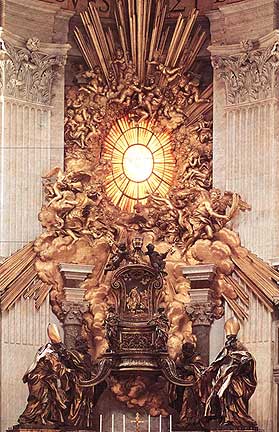
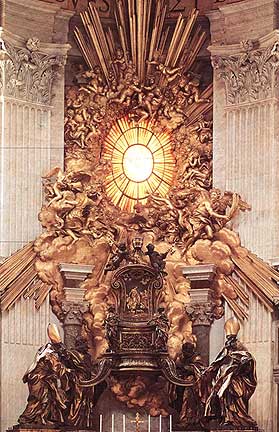
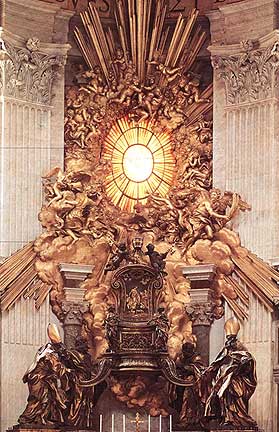
VATICAN CITY, FEB 22, 2006 (VIS) - The Feast of the Chair of St. Peter, which falls today, provided the theme for Benedict XVI's catechesis during the general audience, held this morning in the Paul VI Hall.

This is the feast, said the Pope, "with which we give thanks to God for the mission entrusted to the Apostle Peter and his Successors. The 'cathedra' is literally the seat of the bishop. ... It is the symbol of his authority and, particularly, of his 'Magisterium,' in other words of the evangelical teaching that he, as successor to the Apostles, is called to protect and transmit to the Christian community."

The Holy Father then recalled that the first "seat" of the Church was the Cenacle, saying "it is probable that a special place was reserved for Simon Peter in that room, where Mary Mother of Jesus also prayed together with the disciples. Subsequently, Peter's seat became Antioch." From there, Providence led him to Rome "where he crowned with martyrdom his journey in the service of the Gospel. For this reason the see of Rome, which obtained the greatest honor, also received the obligation entrusted by Christ to Peter to be at the service of all particular Churches, for the edification and unity of the entire People of God."

"To celebrate the 'Chair' of Peter means, then, giving it a strong spiritual significance, and recognizing therein a privileged sign of the love of God, the good and eternal Shepherd Who wishes to unite the whole of His Church and lead her along the way of salvation. ... As the Father of the Church St. Jerome writes: 'I follow no leader save Christ, so I consult the Chair of Peter, for this I know is the rock upon which the Church is built'."

Benedict XVI concluded his catechesis with an invitation to pray, "especially for the ministry with which God has entrusted me. ... Call upon the Holy Spirit to support with His light and strength my daily service to the whole Church."

The audience in the Paul VI Hall was preceded by a meeting in St. Peter's Basilica between the Pope and pilgrims and students from the Italian schools of St. Francis in the city of Lodi, and Mary Immaculate in Rome. The Holy Father told them that "today's feast, inviting us to look to the Chair of St. Peter, encourages us to nourish the individual and community life of faith, founded upon the testimony of Peter and of the other Apostles."
AG/CHAIR PETER/... VIS 060222 (430)

POPE ENCOURAGES THE STUDY OF LATIN

VATICAN CITY, FEB 22, 2006 (VIS) - At the end of the general audience, the Pope addressed a greeting in Latin to students at the faculty of Christian and Classical Literature of the Pontifical Salesian University in Rome.

"My predecessors rightly encouraged the study of [this] great language," said the Pope in Latin, "in order to achieve a better understanding of the sound doctrine contained in the ecclesiastical and humanistic disciplines. In the same way, we encourage the continuation of this activity, so that as many people as possible may perceive the importance of this treasure and attain it."
AG/LATIN/... VIS 060222 (110)

BENEDICT XVI NAMES 15 NEW CARDINALS

VATICAN CITY, FEB 22, 2006 (VIS) - After the general audience today, Feast of the Chair of St. Peter, Benedict XVI announced the names of 15 prelates who will be created cardinals in a concistory due to be held on March 24.

Following the March 24 concistory, the first of his pontificate, the College of Cardinals will number 193 members of whom 120, under the age of 80, will be electors.

In announcing the names, the Holy Father affirmed that today's feast is "a particularly appropriate day" to announce the concistory because cardinals "have the duty to help and support Peter's Successor in carrying out the apostolic task entrusted to him in the service of the Church."

"The cardinals," Benedict XVI went on, "constitute a sort of Senate around the Pope upon which he relies in carrying out the duties associated with his ministry as 'permanent and visible source and foundation of unity of faith and communion'."

The Holy Father also made it clear that with the new appointments he wished "to make up the number of 120 cardinal electors, as established by Pope Paul VI."

Given below is a list of the new cardinal electors:

- Archbishop William Joseph Levada, prefect of the Congregation for the Doctrine of the Faith.

- Archbishop Franc Rode C.M., prefect of the Congregation for Institutes of Consecrated Life and Societies of Apostolic Life.

- Archbishop Agostino Vallini, prefect of the Supreme Tribunal of the Apostolic Signatura.

- Archbishop Jorge Liberato Urosa Savino of Caracas, Venezuela.

- Archbishop Gaudencio B. Rosales of Manila, Philippines.

- Archbishop Jean-Pierre Ricard of Bordeaux, France.

- Archbishop Antonio Canizares Llovera of Toledo, Spain.

- Archbishop Nicholas Cheong Jin-suk of Seoul, Korea.

- Archbishop Sean Patrick O'Malley O.F.M. Cap., of Boston, U.S.A.

- Archbishop Stanislaw Dziwisz of Krakow, Poland.

- Archbishop Carlo Caffarra of Bologna, Italy.

- Bishop Joseph Zen Ze-kiun S.D.B. of Hong Kong, China

The Pope then announced that he had also decided to elevate to the dignity of cardinal "three prelates over the age of 80, in consideration of the service they have rendered to the Church with exemplary faithfulness and admirable dedication." They are:

- Archbishop Andrea Cordero Lanza di Montezemolo, archpriest of the Basilica of St. Paul's Outside-the-Walls.

- Archbishop Peter Poreku Dery, emeritus of Tamale, Ghana.

- Fr. Albert Vanhoye S.J., formerly rector of the Pontifical Biblical Institute and secretary of the Pontifical Biblical Commission.

The new cardinals, said the Pope, "well reflect the universality of the Church. In fact, they come from various parts of the world and undertake different duties in the service of the People of God. I invite you to raise a special prayer to the Lord for them, that He may concede them the grace necessary to carry out their mission with generosity."

In closing, the Holy Father expressed his intention to preside at a concelebration with the new Cardinals on the day following the concistory, March 25 and Solemnity of the Annunciation. "For that occasion I will invite all members of the College of Cardinals, with whom I also intend to hold a meeting of reflection and prayer on March 23," the day prior to the concistory.
AC/CONCISTORY CARDINALS/... VIS 060222 (540)
V.I.S. -Vatican Information Service.
Copyright © Vatican Information Service 00120 Vatican City

Tuesday, February 21, 2006

News From Vatican Information Services 02/21/2006


SUMMARY:

- Telegram for Clashes in Nigeria
- Pope Recalls Don Giussani on First Anniversary of His Death
- Vatican Radio: A Bridge Between the Pope and the World
- Other Pontifical Acts

___________________________________________________________

TELEGRAM FOR CLASHES IN NIGERIA

VATICAN CITY, FEB 21, 2006 (VIS) - Cardinal Secretary of State Angelo Sodano sent a telegram, in the name of the Holy Father, to the ecclesiastical and civil authorities of Nigeria, following recent violent clashes in the north of the country which led to a number of deaths.

"Saddened to learn of the tragic consequences of the recent violent protests in northern Nigeria, His Holiness Pope Benedict XVI assures all those affected of his closeness in prayer and commends the late Reverend Father Michael Gajere and all the deceased to the loving mercy of the Almighty. Upon their grieving families the Holy Father invokes divine blessings of strength and consolation. He likewise prays for all involved in providing security, encouraging them in their efforts to ensure peace and to promote the rule of law for which all people of good will long."
TGR/NIGERIA/SODANO VIS 060221 (150)

POPE RECALLS DON GIUSSANI ON FIRST ANNIVERSARY OF HIS DEATH

VATICAN CITY, FEB 21, 2006 (VIS) - Made public today was a letter from the Pope addressed to Fr. Julian Carron, president of the Communion and Liberation association and successor to Msgr. Luigi Giussani, founder of the same association, the first anniversary of whose death falls tomorrow.

In his Letter, the Holy Father recalls Msgr. Giussani as "a father and teacher of so many young people to whom he indicated Christ as the center of their lives." The Pope also gives thanks to God "for the gift of such a zealous pastor, who loved man because he loved Christ."

Benedict XVI continues: "With emotion I recall the solemn celebration of his funeral in the Duomo of Milan, when I had a further opportunity to note the respect and appreciation that he, in the course of his fruitful life, was able to arouse around his person, his teaching and his apostolic work.

"As I said during the funeral service, the most striking things about Don Giussani were his solid faithfulness to Christ and his incessant efforts to communicate the wealth of the evangelical message to all social groups."

The Pope then calls on Don Giussani's spiritual followers to continue "in his footsteps and his teaching," and always to remain "in communion with bishops and other ecclesial figures. To that end, I give assurances of my prayers, asking the Lord that Communion and Liberation may serve the cause of the Gospel with joy, continuing the work begun by their venerated predecessor."
BXVI-LETTER/DON GIUSSANI/CARRON VIS 060221 (260)

VATICAN RADIO: A BRIDGE BETWEEN THE POPE AND THE WORLD

VATICAN CITY, FEB 21, 2006 (VIS) - A press conference was held this morning in the Holy See Press Office to mark the 75th anniversary of Vatican Radio. The title of the conference was "Vatican Radio at 75. New ways to serve the Church and future prospects."

Fr. Federico Lombardi S.J., director general of Vatican Radio recalled how the mission of the station, as laid down in its Statutes, is: "To announce the Christian message freely, faithfully and effectively, and to link the center of Catholicism with the countries of the world by: diffusing the voice and teachings of the Roman Pontiff; providing information on the activities of the Holy See; reflecting Catholic life around the world; and encouraging the evaluation of contemporary problems in the light of ecclesial Magisterium and with constant attention for the signs of the times."

Fr. Lombardi, pointed out how Vatican Radio is characterized by its flexible and multicultural approach, transmitting programs in 45 languages. Radio in a general sense, he added, "is vital everywhere and in some parts of the world - such as, for example, Africa - it is the means most capable of deep and effective penetration."

After explaining how Vatican Radio has passed from analogue to digital technology and is experimenting with "digital transmissions on medium- and short-wave" frequencies, Fr. Lombardi revealed that the station has also developed "an original system for publishing text and audio files on Internet, in many different languages and alphabets." Through its web site http://www.radiovaticana.org/ the station is able "to act as a news agency, especially for those countries in which no Catholic news agency exists, and to carry out a useful service for the lay world of communication, e.g., the Japanese page, which is the most visited for searches under the word 'Vatican'."

Fr. Lombardi concluded his remarks by highlighting the fact that Vatican Radio offers training courses to young journalists and students of social communications, "an average of 50 a year," although "there were 140 during the Jubilee Year 2000."

Vatican Radio currently employs 384 people - priests, religious and male and female lay people - from 59 countries. Its average daily transmission time is 64 hours, and its annual running expenses stand in the region of 25-30 million euro, of which 57 percent represent staff costs.

Fr. Andrzej Koprowski S.J., director of programs at the station, recalled how one of the objectives of Vatican Radio is that of being "a bridge between the Holy Father - the Holy See - the Universal Church and the respective societies and the respective particular Churches."

Fr. Koprowski mentioned the language sections of Vatican Radio in the media and ecclesial context of the world. Each of these sections, he said, "came into being at specific moments in the life of the Church and the world," explaining how after World War II and the Communist takeover in the countries of eastern Europe the station directed its efforts towards the countries and particular Churches that were suffering most. "For this reason," he added, "we have a wealth of programs and languages above all from European countries, especially eastern and southern Europe."

In our own times and with a view to the future, Fr. Koprowski went on, Vatican Radio remains highly aware "of the development of the Church in Latin America, Africa and Asia." He made particular reference to "Arabic language and culture, which is no longer the exclusive preserve of the Middle East but also of various regions of Europe and the world, because the view of the 'Arab world' and the 'Muslim world' is not just a political matter, but also a cultural, social and ecclesial question of primary importance, as the last few weeks have shown."

Another key area identified by Fr. Koprowski is Asia. "We know of the development of the Church in India, and we are aware of the role Indian Christianity has for the future of the Universal Church, just as we are aware of ... the vital need for the Church to enter into dialogue and to understand the cultures of other countries in the immense continent of Asia: China, Japan, Vietnam, etc."

Fr. Koprowski concluded by referring to the cultural and religious situation in former-Communist European countries, which "currently favors new forms of collaboration through the local media, both public and private, Catholic and non-Catholic."
OP/VATICAN RADIO/LOMBARDI VIS 060221 (740)

OTHER PONTIFICAL ACTS

VATICAN CITY, FEB 21, 2006 (VIS) - The Holy Father:

- Appointed Msgr. Eduardo Eliseo Martin vicar general and pastor of the cathedral of the diocese of Venado Tuerto, Argentina, as bishop of Villa de la Concepcion del Rio Cuarto (area 58,516, population 412,000, Catholics 391,400, priests 91, permanent deacons 17, religious 75), Argentina. The bishop-elect was born in Venado Tuerto in 1953 and ordained a priest in 1980. He succeeds Bishop Ramon Artemio Staffolani, whose resignation from the pastoral care of the same diocese, the Holy Father accepted, upon having reached the age limit.

- Appointed Cardinal Attilio Nicora, president of the Administration of the Patrimony of the Apostolic See, as pontifical legate to the Basilicas of St. Francis and of St. Mary of the Angels in Assisi, Italy.
NER:RE:NA/.../MARTIN:STAFFOLANI:NICORA VIS 060221 (140)
V.I.S. -Vatican Information Service.
Copyright © Vatican Information Service 00120 Vatican City


Friday, February 17, 2006

News From Vatican Information Services 02/17/2006


SUMMARY:

- Civilta Cattolica: Faithfully Divulge Church Teaching
- In Brief
- Audiences
- Other Pontifical Acts

___________________________________________________________

CIVILTA CATTOLICA: FAITHFULLY DIVULGE CHURCH TEACHING

VATICAN CITY, FEB 17, 2006 (VIS) - This morning, Benedict XVI received journalists and editors from the Italian magazine "Civilta Cattolica," which is run by the Jesuits, recalling that Blessed Pius IX had "perpetually instituted" the publication in 1850, "giving it a particular statue that established a special link with the Holy See."

In order for the magazine to remain "faithful to its character and its duty," said the Pope, it must "continually renew itself, correctly interpreting 'the signs of the times'." Faced with the spread of "individualistic relativism and positivistic science, ... closed to God and His moral law though not always prejudiced against Christianity, ... Catholics are called to develop dialogue with modern culture, opening it up to the perennial values of transcendence."

The Holy Father also indicated the "many signs of hope" in today's world, such as "a new sensitivity to religious values, ... renewed interest in Sacred Scripture, greater respect for human rights, and the desire to establish dialogue with other religions. In particular, faith in Jesus can help many to grasp the meaning of life and of the human adventure, giving them the points of reference that are often lacking in so frenetic and disoriented a world."

In this context, Benedict XVI identified the mission of a magazine like "Civilta Cattolica" as being "to participate in the modern cultural debate, both to propose - seriously but also in a way accessible to all - the truths of Christian faith with clarity and faithfulness to the Church's Magisterium, and to defend, with no desire for controversy, the truth which is sometimes distorted by baseless accusations leveled against the ecclesial community."

The Pope indicated Vatican Council II as a "beacon" to guide the magazine. "The doctrinal and pastoral wealth it contains," he said, "have not yet been fully assimilated by the Christian community, even though 40 years have passed since its conclusion."

He concluded by saying that "Civilta Cattolica" must "divulge and support the action of the Church in all areas of her mission. The magazine must give particular emphasis to spreading the Church's social doctrine, one of the themes it has covered most fully in its 155 years of life."
AC/CIVILTA CATTOLICA/... VIS 060217 (380)

IN BRIEF

CARDINAL SECRETARY OF STATE ANGELO SODANO sent a telegram of condolence, in the name of the Holy Father, to Bishop Precioso D. Cantillas S.D.B., of Maasin, Philippines for the huge landslide which engulfed two villages in that country. The Holy Father offers fervent prayers for the dead, invoking divine consolation upon the relatives of the victims and calling for relief efforts to be swift and generous.

MIGUEL ANGEL MORATINOS, FOREIGN MINISTER OF SPAIN, met this morning with Cardinal Secretary of State Angelo Sodano. During the cordial meeting, bilateral relations between Spain and the Holy See were examined. The minister guaranteed the complete readiness of his government to welcome Benedict XVI when he visits the Spanish city of Valencia in July for the 4th International Meeting of Families, and invited the Holy See to support the Spanish-government initiative: "An Alliance of Civilizations between the Western World and the Arab-Islamic World."
.../IN BRIEF/... VIS 060217 (160)

AUDIENCES

VATICAN CITY, FEB 17, 2006 (VIS) - The Holy Father today received in separate audiences six prelates from the Conference of Bishops of Senegal, Mauritania, Cape Verde and Guinea-Bissau, on their "ad limina" visit:

- Bishop Maixent Coly of Ziguinchor, Senegal.

- Bishop Martin Albert Happe M. Afr., of Nouakchott, Mauritania.

- Bishop Arlindo Gomes Furtado of Mindelo, Cape Verde.

- Bishop Paulino do Livramento Evora C.S.Sp., of Santiago de Cabo-Verde, Cape Verde.

- Bishop Carlos Pedro Zilli P.I.M.E., of Bafata, Guinea-Bissau.

- Bishop Jose Camnate na Bissign of Bissau, Guinea-Bissau.

This evening he is scheduled to receive in audience Archbishop Angelo Amato S.D.B., secretary of the Congregation for the Doctrine of the Faith.
AL:AP/.../... VIS 060217 (120)

OTHER PONTIFICAL ACTS

VATICAN CITY, FEB 17, 2006 (VIS) - The Holy Father:

- Appointed Msgr. Lorenzo Ghizzoni, director of the episcopal seminary of Reggio Emilia, Italy, and vice-director of the national vocational center, as auxiliary of Reggio Emilia-Guastalla (area 2,394, population 508,677, Catholics 485,527, priests 337, permanent deacons 67, religious 444), Italy. The bishop-elect was born in Cognento, Italy in 1955 and ordained a priest in 1979.

- Gave his assent to the canonical election by the Synod of Bishops of the Greek-Melkite Church meeting in Ain Traz, Lebanon, from February 6 to 11, 2006, of Archimandrite Elias Chacour, pastor of Ibillin and president of the Mar Elias Educational Institutions, as archbishop of Akka of the Greek-Melkites (Catholics 67,890, priests 39, religious 59), Israel. The archbishop-elect was born in Biram in 1939 and ordained a priest in 1965.
NEA:NER/.../GHIZZONI:CHACOUR VIS 060217 (140)
V.I.S. -Vatican Information Service.
Copyright © Vatican Information Service 00120 Vatican City

Thursday, February 16, 2006

News From Vatican Information Services 02/16/2006


SUMMARY:

- Lebanese People Confirm Their Devotion to the Pope
- Vatican Radio: New Ways to Serve the Church
- Audiences

___________________________________________________________

LEBANESE PEOPLE CONFIRM THEIR DEVOTION TO THE POPE

VATICAN CITY, FEB 16, 2006 (VIS) - Given below is the text of a communique released by the Holy See Press Office following today's visit to the Vatican by Fouad Siniora, prime minister of Lebanon:

"Today, February 16, 2006, the Holy Father Benedict XVI received in audience Fouad Siniora, prime minister of Lebanon. The prime minister subsequently went on the meet with Cardinal Secretary of State Angelo Sodano.

"The visit of the head of the Lebanese government and of the official delegation accompanying him, had the aim of confirming the great devotion of the Lebanese people towards the Roman Pontiff, and towards the Holy See in general, which has always remained close to that noble country.

"In the course of the discussions, opinions were exchanged concerning the current situation in Lebanon and in the Middle East in general, highlighting the joint commitment to work towards educating people in reconciliation and peace, while respecting human rights, especially that of religious freedom.

"Particular attention was reserved for the situation of Christians and for the contribution they intend to make to the progress of the country, in keeping with the guidelines laid down, prior to the Jubilee 2000, by the Apostolic Exhortation "A new hope for Lebanon," of Pope John Paul II, of blessed memory."
OP/.../SINIORA VIS 060216 (220)

VATICAN RADIO: NEW WAYS TO SERVE THE CHURCH

VATICAN CITY, FEB 16, 2006 (VIS) - In the Holy See Press Office at 11.30 a.m. on Tuesday, February 21, a press conference will be held to mark the 75th anniversary of Vatican Radio. The conference is entitled "Vatican Radio at 75. New ways to serve the Church and future prospects."

Participating in the event will be Frs. Federico Lombardi S.J. and Andrzej Koprowski S.J., respectively director general and director of programs; Sandro Piervenanzi, technical vice-director, and Pietro Cocco, head of the Vatican Radio Web Team.
OP/VATICAN RADIO/LOMBARDI VIS 060216 (100)

AUDIENCES

VATICAN CITY, FEB 16, 2006 (VIS) - The Holy Father today received in separate audiences:

- Fouad Siniora, prime minister of Lebanon, accompanied by his wife and an entourage.

- Six prelates from the Conference of Bishops of Senegal, Mauritania, Cape Verde and Guinea-Bissau, on their "ad limina" visit:

- Archbishop Theodore-Adrien Sarr of Dakar.

- Bishop Benjamin Ndiaye of Kaolack.

- Bishop Jean-Pierre Bassene of Kolda.

- Bishop Ernest Sambou of Saint-Louis du Senegal.

- Bishop Jean-Noel Diouf of Tambacounda.

- Bishop Jacques Sarr of Thies.

This evening, he is scheduled to meet Archbishop Fortunato Baldelli, apostolic nuncio to France.
AP:AL/.../... VIS 060216 (110)
V.I.S. -Vatican Information Service.
Copyright © Vatican Information Service 00120 Vatican City

Wednesday, February 15, 2006

News From Vatican Information Services 02/15/2006


SUMMARY:

- Benedict XVI Concludes Catechesis of John Paul II
- Message to Cubans: Open Your Hearts to God and the World
- Other Pontifical Acts

___________________________________________________________

BENEDICT XVI CONCLUDES CATECHESIS OF JOHN PAUL II

VATICAN CITY, FEB 15, 2006 (VIS) - At the beginning of the general audience Benedict XVI recalled that today's catechesis was the last "of the long cycle begun years ago by my beloved predecessor, the unforgettable John Paul II," who wished to cover "the entire sequence of Psalms and Canticles that constitute the basic fabric of the Liturgy of the Hours and of Vespers.

"Having reached the end of this textual pilgrimage - like a journey through a flower garden of praise, invocation, prayer and contemplation - we now come to the canticle that closes the celebration of Vespers: the Magnificat."

The Pope went on: "It is a canticle that reveals ... the spirituality ... of those faithful who recognized themselves as 'poor,' not only in detaching themselves from all forms of idolatry of wealth and power, but also in profound humility of heart, free from the temptation to pride and open to the irruption of divine saving grace."

If the first part of the Magnificat, the Holy Father explained, is "the celebration of divine grace which irrupted into the heart and the life of Mary, making her Mother of the Lord," Mary's personal witness was nonetheless "not solitary, ... because the Virgin Mother was aware she had a mission to achieve for humanity, and her own story is part of the history of salvation."

In the second part, "the voice of Mary is joined by the entire community of faithful" who celebrate God's actions in history. "The 'style' that inspires the Lord of history is clear: He takes the side of the least and the lowliest." On this subject, the Pope quoted the words of St. Ambrose: "May each one of us glorify the Lord with the soul of Mary. ... If, according to the flesh, the mother of Christ is one, then according to the faith, all souls generate Christ."

Prior to the general audience, which was held in the Paul VI Hall, the Pope went to the Vatican Basilica to greet a group of Italian students and participants in a pilgrimage promoted by the French religious family, "Freres de Saint-Jean."

Addressing the students, Benedict XVI spoke of his recent Encyclical "Deus caritas est," recalling that "the love of God is the source and motive for our true joy. I invite each of you to understand and accept ever more this Love that changes life and renders you credible witnesses of the Gospel."

The Holy Father then turned to the participants in the pilgrimage of the "Freres de Saint-Jean" who are celebrating the 30th anniversary of the foundation of their organization. "May your pilgrimage be a time of renewal, one in which to analyze the experiences you have had, learn the appropriate lessons, and discern with ever greater profundity the vocations that arise and the missions to which you are called, in trusting collaboration with the pastors of local churches."
AG/MAGNIFICAT/FRERES SAINT-JEAN VIS 060215 (500)

MESSAGE TO CUBANS: OPEN YOUR HEARTS TO GOD AND THE WORLD

VATICAN CITY, FEB 15, 2006 (VIS) - Made public today was a Message from the Pope to Cardinal Jaime Ortega y Alamino, archbishop of San Cristobal de La Habana and president of the Conference of Catholic Bishops of Cuba, for the occasion of the 20th anniversary of the Cuban National Ecclesial Encounter.

In his Message, dated February 2, Feast of the Presentation of the Lord, the Holy Father sends affectionate greetings to the bishops, priests, consecrated people and laity of Cuba, expressing his "spiritual closeness" and "encouragement for their evangelizing tasks."

On this anniversary, writes Benedict XVI, it would be particularly appropriate to recall the words used by John Paul II on his visit to Cuba in 1998: "May Cuba open to the world, and may the world open to Cuba." Such openness, the Pope says, "requires us first of all to consider how to open heart and understanding to the things of God; how those who coexist can open to one another, believing and trusting in each another though with different ways of thinking and believing; and finally, how to open to the world, with its challenges, its possibilities and its difficulties."

"Only through the gaze of God, a loving gaze, will it be possible to arrive at the truth of each individual, of each group and of those who live together in one land. On this journey, ... much help may be gained from each Christian's experience of prayer, in the silence and humility of daily work, in faithfulness to professed faith, in the implicit or explicit announcement of the Gospel. Much help is also to be had from the love of majority of Cubans for the 'Madre de la Cardida del Cobre," patroness of this land for so long, who accompanies its inhabitants with motherly tenderness."
MESS/NATIONAL ECCLESIAL ENCOUNTER/CUBA:ORTEGA VIS 060215 (320)

OTHER PONTIFICAL ACTS

VATICAN CITY, FEB 15, 2006 (VIS) - The Holy Father appointed Archbishop Michael Louis Fitzgerald M. Afr., president of the Pontifical Council for Inter-religious Dialogue, as apostolic nuncio to the Arab Republic of Egypt and delegate to the Organization of the League of Arab States.
NN/.../FITZGERALD VIS 060215 (50)
V.I.S. -Vatican Information Service.
Copyright © Vatican Information Service 00120 Vatican City

Tuesday, February 14, 2006

News From Vatican Information Services 02/14/2006


SUMMARY:

- Initiatives for Fifth Centenary of Vatican Museums
- World Council of Churches Meeting in Brazil
- Solid Partnership with the World Council of Churches
- Other Pontifical Acts

___________________________________________________________

INITIATIVES FOR FIFTH CENTENARY OF VATICAN MUSEUMS

VATICAN CITY, FEB 14, 2006 (VIS) - In the Holy See Press Office this morning, Cardinal Edmund Casimir Szoka, president of the Governorate of Vatican City State, and Francesco Buranelli, director of the Vatican Museums, held a press conference to present initiatives for the commemoration of the fifth centenary of the Vatican Museums.

"This is not a conventional or a merely symbolic anniversary," said Cardinal Szoka, "it marks the chance but fortunate discovery of the marble statue of Laocoon and his sons in 1506. The anniversary seeks to unify a centuries-long history of culture and art promoted with constancy and competency by the Roman Pontiffs, who collected the works of the past to save them from oblivion and destruction, and to hand them down to later generations."

The cardinal indicated that the Vatican Museums, visited annually by four million people, "house a centuries-old heritage, and not only a material heritage. The museums are responsive of their duty to conserve and transmit ... to future generation these expressions of genius, of life, of thought and of spirituality from the past; and they will continue to do so, without seeking to avoid the challenges of the present, with the perseverance and conviction that has always marked them."

For his part, Francesco Buranelli, director of the Vatican Museums, outlined the various initiatives planned to mark the fifth centenary throughout the year 2006.

The official commemoration will begin on Friday, February 17, with the celebration of a Mass of thanksgiving in the Sistine Chapel, presided by Cardinal Szoka and attended by the entire personnel of the Vatican Museums.

During the first half of 2006, two important museums, recently restored, will be reopened to the public. "They exemplify the commitment of the Roman Pontiffs to promoting evangelization through the language of art," said Francesco Buranelli. The first of these is the Pio Christian Museum founded by Benedict XIV between 1756 and 1757 to house the various objects acquired by the Vatican during the first half of the eighteenth century, and "to promote the splendor of Rome and affirm the truth of the Christian religion." This museum will open on March 16 with an exhibition dedicated to finds made in the Roman catacombs during the eighteenth century, exhibited in glass cases decorated with busts of 24 cardinal librarians.

The second gallery to open will be the Missionary Ethnological Museum. Founded by Pius XI in 1926, it was housed in the Lateran Palace until 1963 when Blessed John XXIII decided to move it to the Vatican. The museum, which opened to the public ten years later under the pontificate of Paul VI, presents the cultures and religious practices of non-European countries, and their contacts with Christianity. The sections dedicated to China, Japan, Korea, Tibet and Mongolia are due to open on June 20.

Following their complete restoration, the wall paintings of the Room of Mysteries in the Borgia Apartment, the work of Pinturicchio and his assistants, will be presented on April 27. The lunettes, decorated with scenes from the lives of Jesus and Mary, have been cleaned, while restoration work also revealed a series of ornamental decorations hidden for more than thirty years behind heavy tapestries.

In the autumn, a new section of the Roman necropolis on the Via Triumphalis will be opened, discovered thee years ago during work on the new Santa Rosa parking lot in the Vatican. It will be possible to visit around 30 mausolea and 70 individual tombs dating from the first century BC to the third century AD.

The anniversary celebration will come to an end in November with the exhibition: "Laocoon. At the origins of the Vatican Museums." The event will be accompanied by an international congress on the theme of the identity, essence and role of museums in modern society.
.../VATICAN MUSEUMS/SZOKA:BURANELLI VIS 060214 (640)

WORLD COUNCIL OF CHURCHES MEETING IN BRAZIL

VATICAN CITY, FEB 14, 2006 (VIS) - Cardinal Walter Kasper, president of the Pontifical Council for Promoting Christian Unity, is due to participate in the inaugural session of the ninth general assembly of the Geneva-based World Council of Churches (WCC). The meeting is being held at Porto Alegre, Brazil, from February 14 to 23 on the theme: "God in Your Grace, transform the world."

A communique made public today indicates that the general assembly is the WCC's most important governing body and is held every seven years. It is expected that the Brazil meeting will be attended by 3,000 participants, including more than 700 official delegates representing the 340 churches and ecclesial communities affiliated to the WCC, organizations otherwise associated with the WCC, and non-affiliated churches.

According to the program, each day will begin with a joint prayer and a small group of biblical reflection; this will be followed by three plenary sessions and a joint evening prayer. One of the assembly's main tasks will be to appoint the members of the new central committee which will oversee implementation of the WCC activities until the next assembly in 2013.

Bishop Brian Farrell, secretary of the Pontifical Council for Promoting Christian Unity, will head the official Catholic delegation, made up of 18 members who will act as observers. These include representatives from the Roman Curia, episcopal conferences and lay movements, as well as religious superiors.

The Catholic Church, the communique concludes, is not a member of the WCC, though it collaborates with the organization in various ways, particularly with its Faith and Constitution Commission which has the task of continuing the search for the unity of Christians by promoting common study and reflection on subjects over which division still exists, such as ecclesiology. The Joint Working Group, instituted in 1965, is the principal structure coordinating relations between the Catholic Church and the WCC.
CON-UC/WCC ASSEMBLY/BRAZIL VIS 060214 (320)

SOLID PARTNERSHIP WITH THE WORLD COUNCIL OF CHURCHES

VATICAN CITY, FEB 14, 2006 (VIS) - Benedict XVI has written a message to Cardinal Walter Kasper, president of the Pontifical Council for Promoting Christian Unity, for the occasion of the ninth general assembly of the Geneva-based World Council of Churches (WCC), which is being held at Porto Alegre, Brazil, from February 14 to 23.

In the English-language text, Benedict XVI writes: "Mindful of our shared baptismal faith in the Triune God, the Catholic Church and the World Council of Churches seek ways to cooperate ever more effectively in the task of witnessing to God's divine love. After 40 years of fruitful collaboration, we look forward to continuing this journey of hope and promise, as we intensify our endeavors towards reaching that day when Christians are united in proclaiming the Gospel message of salvation to all."

The Pope concludes with assurances of his spiritual closeness to those participating in the Porto Alegre meeting, and reaffirms "the Catholic Church's intention to continue a solid partnership with the World Council of Churches."
MESS/WORLD COUNCIL CHURCHES/KASPER VIS 060214 (180)

OTHER PONTIFICAL ACTS

VATICAN CITY, FEB 14, 2006 (VIS) - The Holy Father:

- Confirmed Cardinal Camillo Ruini, his vicar general for the diocese of Rome, as president of the Italian Episcopal Conference, "donec aliter provideatur."

- Appointed Fr. Alessandro Perego of the clergy of the diocese of Rome, as defender of the bond at the Tribunal of the Roman Rota.
NA/.../RUINI:PEREGO VIS 060214 (70)
V.I.S. -Vatican Information Service.
Copyright © Vatican Information Service 00120 Vatican City

Monday, February 13, 2006

News From Vatican Information Services 02/11-13/2006


SUMMARY: FEBRUARY 11 - 13

- Experience Illness in Keeping with Human Dignity
- Christ Is the Hand of God Reaching out to Humanity
- Pope Meets with Cardinals and Heads of Dicasteries
- Other Pontifical Acts

___________________________________________________________

EXPERIENCE ILLNESS IN KEEPING WITH HUMAN DIGNITY

VATICAN CITY, FEB 11, 2006 (VIS) - In the Vatican Basilica at 4.30 p.m. today, Feast of Our Lady of Lourdes and the 14th World Day of the Sick, Cardinal Camillo Ruini, vicar general for the diocese of Rome, celebrated Mass for the sick and for pilgrims of UNITALSI (Italian National Union for Transport of the Sick to Lourdes and International Shrines), and of Opera Romana Pellegrinaggi.

Following Mass, Benedict XVI arrived in the basilica to bless the sick and address some words to those present.

The Pope recalled how "in the grotto of Massabielle, the Virgin showed the tenderness of God towards those who suffer. ... Appearing to Bernadette as the Immaculate Conception, Mary Most Holy came to remind the modern world, which risked forgetting, of the primacy of divine Grace which is stronger than sin and death."

The Holy Father went on to refer to a congress held in the Australian city of Adelaide on February 9 and 10, promoted by the Pontifical Council for Health Care Ministry on the theme: "Mental health and human dignity."

"The human person," he said, "is a single entity the various dimensions of which may be distinguished but not separated. The Church always aims to consider persons in this light, and this concept characterizes both Catholic health care institutions, and the approach of those who work in them."

Benedict XVI made a special appeal for those suffering mental illness and for their families: "We feel close to [people in] such situations, with our prayers and with the numerous initiatives implemented by the ecclesial community all over the world, especially in places where legislation is lacking, where public structures are insufficient and where natural disasters or, alas, war and armed conflict, create grave psychological trauma in individuals."

"To all doctors, nurses and other health care workers, and all volunteers who work in this field, I would like today symbolically to consign the Encyclical 'Deus caristas est,' with the hope that God may ever remain alive in their hearts, so as to animate their daily work, their projects, their initiatives and above all their relationship with the sick. Acting in the name of charity and in the way of charity, you also offer your precious contribution to evangelization, because the announcement of the Gospel has need of coherent signs to confirm it. And these signs speak the language of universal love, a language that everyone can understand."

The Pope concluded his address by calling on the Virgin Mary "to keep our hope alive so that, faithful to Christ's teaching, we may renew our commitment to raise up our brothers and sisters in their sickness. May the Lord ensure that people do not remain alone and abandoned at the moment of need but, rather, that they may experience even illness in accordance with human dignity."
AC/WORLD DAY SICK/... VIS 060213 (480)

CHRIST IS THE HAND OF GOD REACHING OUT TO HUMANITY

VATICAN CITY, FEB 12, 2006 (VIS) - The World Day of the Sick, celebrated on February 11, Feast of Our lady of Lourdes, provided the main theme for Benedict XVI's remarks before praying the Angelus this morning with thousands of pilgrims gathered in St. Peter's Square.

"Sickness," said the Pope, "is such a typical characteristic of the human condition that it can even become a realistic metaphor thereof. St. Augustine expresses this well in one of his prayers: 'Have mercy on me, Lord! See, I do not hide my wounds from You. You are my doctor, I am the sick man.' ... Christ is the true 'doctor' of humanity, Whom the heavenly Father sent into the world to cure mankind, marked in body and spirit by sin and the consequences of sin."

The Holy Father then made reference to the Gospel of St. Mark, which is being read over these Sundays "and presents us with Jesus Who, at the beginning of His public ministry, dedicates Himself entirely to preaching and to curing the sick in the villages of Galilee. The innumerable prodigies He performs on the sick confirm the 'Good News' of the Kingdom of God."

Today's specific Gospel text recounts the healing of a leper "and very effectively expresses the intensity of the relationship between God and man," the Pope said. "Here we see the entire history of salvation in concentrated form," he added.

"That gesture of Jesus, Who stretches out His hand and touches the scarred body of the person who calls on Him, perfectly expresses God's will to restore His fallen creature to health, giving him back 'abundant life' - eternal, full and joyful life. Christ is 'the hand' of God reaching out to humanity, that it may escape from the quicksands of sickness and death, and stand on its own feet on the solid rock of divine love."

The Pope concluded his remarks by entrusting "to Mary, 'Salus infirmorum,' all sick people, especially those who, all over the world, in addition to poor health, also suffer from solitude, poverty and marginalization."

Following the Angelus, Benedict XVI recalled that the 20th Winter Olympic Games are currently being held in the Italian city of Turin. "I hope this magnificent sporting competition may take place in accordance with the Olympic values of loyalty, joy and fraternity," he said, "thus contributing to peace among peoples."

Finally, the Pope referred to the 75th anniversary of the inauguration of Vatican Radio, which falls today February 12, and to "the first radio message to the world, delivered by Pope Pius XI who commissioned the scientist Guglielmo Marconi to build the Vatican radio station. By means of radio, and later of television, it has been possible to bring the Gospel message and the words of the Popes to all peoples more quickly and easily."
ANG/SICK:OLYMPIC GAMES:VATICAN RADIO/... VIS 060213 (490)

POPE MEETS WITH CARDINALS AND HEADS OF DICASTERIES

VATICAN CITY, FEB 13, 2006 (VIS) - In the Bologna Hall of the Vatican Apostolic Palace at 10.30 a.m. today, Benedict XVI presided at a meeting of cardinals and heads of dicasteries of the Roman Curia.
.../MEETING CARDINALS:HEADS DICASTERY/... VIS 060213 (50)

OTHER PONTIFICAL ACTS

VATICAN CITY, FEB 13, 2006 (VIS) - The Holy Father appointed Fr. Edmundo Ponziano Valenzuela Mellid S.D.B., missionary in Angola, as apostolic vicar of Chaco Paraguayo (area 96,030, population 18,200, priests 5, religious 9), Paraguay. The bishop-elect was born in Villarrica del Espiritu Santo, Paraguay in 1944 and ordained a priest in 1971.

On Saturday, February 13, it was made public that he:

- Accepted the resignation from the office of auxiliary of the diocese of Lomza, Poland, presented by Bishop Tadeusz Jozef Zawistowski, upon having reached the age limit.

- Appointed Msgr. Tadeusz Bronakowski of the clergy of the diocese of Lomza, Poland, teacher of canon law at the major seminary and vice-chancellor of the diocesan curia, as auxiliary of the same diocese (area 11,500, population 573,647, Catholics 567,035, priests 476, religious 213). The bishop-elect was born in Augustow, Poland in 1959 and ordained a priest in 1984.

- Accepted the resignation from the office of auxiliary of the archdiocese of Montreal, Canada, presented by Bishop Jude Saint-Antoine, upon having reached the age limit.

- Appointed Fr. Lionel Gendrom P.S.S., provincial superior for Canada of the Suplician Fathers, and Fr. Andre Gazaille of the clergy of the archdiocese of Montreal, Canada pastor of the parishes of 'Saints-Martyrs-Canadiens,' 'Visitation de la Bienheureuse-Vierge-Marie,' and 'Saint-Antoine-Marie-Claret,' as auxiliaries of the archdiocese of Montreal (area 1,399, population 2,340,928, Catholics 1,590,150, priests 1,283, permanent deacons 103, religious 5,881). Bishop-elect Gendrom was born in Saint-Quintin, Canada in 1944 and ordained a priest in 1969. Bishop-elect Gazaille was born in Montreal in 1946 and ordained a priest in 1971.

- Appointed Fr. Peter Joseph Hundt of the clergy of the diocese of Hamilton, Canada, pastor of the parish of the Holy Cross in Georgetown, Ontario, as auxiliary of the archdiocese of Toronto (area 13,000, population 5,043,085, Catholics 1,363,657, priests 811, permanent deacons 96, religious 1,178), Canada. The bishop-elect was born in Hanover, Canada in 1956 and ordained a priest in 1982.

- Appointed Fr. Aloisio Jorge Pena Vitral of the clergy of the archdiocese of Belo Horizonte, Brazil, pastor of the parish of 'Nossa Senhora das Dores,' and Fr. Joaquim Giovanni Mol Guimaraes of the clergy of the archdiocese of Belo Horizonte, pastor of the parish of 'Santa Maria Mae de Deus' and vice-rector of the Pontifical Catholic University in Minas Gerais, as auxiliaries of the archdiocese of Belo Horizonte (area 7,240, population 4,216,719, Catholics 3,162,539, priests 572, religious 2,252). Bishop-elect Pena Vidral was born in Rio de Janeiro, Brazil in 1955 and ordained a priest in 1986. Bishop-elect Mol Guimaraes was born in Ponte Nova, Brazil in 1960 and ordained a priest in 1988.
NER:RE:NEA/.../... VIS 060213 (450)
V.I.S. -Vatican Information Service.
Copyright © Vatican Information Service 00120 Vatican City
DreamHost discount