Thursday, September 14, 2006

News Vatican Information Services 09/14/2006


SUMMARY OF POPE'S APOSTOLIC TRIP TO GERMANY:

- Servants and "Voices" of Christ, Who Is Master of the Word
- Pope Bids an Emotional Farewell to His Homeland

___________________________________________________________

SERVANTS AND "VOICES" OF CHRIST, WHO IS MASTER OF THE WORD

VATICAN CITY, SEP 14, 2006 (VIS) - This morning, the Holy Father left Regensburg and travelled by helicopter to the city of Freising which, in the past, was a trading center for the whole of central Europe, and today it is an important hub for agriculture and the food industry. It has a famous university and holds the administrative offices of the archdiocese of Munich and Freising. The archiepiscopal see is in Munich itself.

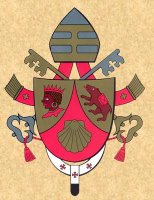
Benedict XVI's papal coat-of-arms contains three references to Bavaria, of which two to Freising: a Moor's head, the traditional symbol of the diocese of Freising, and a bear with a pack saddle, a reference to the bear of St. Corbinian, the eighth-century bishop of Freising who tamed the beast after it attacked him. The pack saddle is meant to represent the burden of the episcopate.

From the heliport of Freising, the Holy Father travelled by car to the city cathedral, built in 1205 and dedicated to Sts. Mary and Corbinian, where he met with priests and permanent deacons. It was here, on June 29, 1951, that Joseph Ratzinger was ordained a priest. He later taught theology in the diocesan seminary. The meeting with clergy was attended by 30 priests ordained the same day as the pontiff.

The Pope, putting aside the text of his prepared address, limited himself to commenting that text in off-the-cuff remarks.

"This is my last meeting before taking leave of my beloved Bavaria, and I am pleased that it is taking place with you, the priests and permanent deacons, the living and chosen stones of the Church," reads the text of the Pope's prepared address. "When I look around this magnificent cathedral of Freising, so many memories come back to me of the years when my journey to the priesthood and the exercise of my ministry were linked to this place."

The central theme of the Pope's remarks was the Gospel of St. Matthew, where "Jesus sees in the people gathered around Him the 'harvest' of God the Father, ready for reaping."

"Christ sees the world as 'God's field,' in which a rich harvest is growing and there is need of reapers. ... The fundamental approach of Jesus ... is one of optimism, based on confidence in the power of the Father, the 'Lord of the harvest.' Jesus' confidence becomes for us a source of hope."

"A priest's life and the real nature of his vocation and ministry are contained in the worldview revealed to us by Jesus. This same worldview moved the Lord to go from village to village, teaching in the synagogues, preaching the good news of the Kingdom and healing the sick."

Underlying the generosity of Christ, Pope Benedict's prepared address continues, "is a confidence in the power of the Father. ... By his progressive assimilation to the sentiments of the Teacher, the priest will come to share in His confident approach. By entering more and more deeply into Jesus' own way of seeing things, he learns to see all around him as the 'harvest of God'."

"Nevertheless, we must always keep in mind the words of our biblical text: it is the 'Lord of the harvest' who 'sends' laborers into His harvest. Jesus did not give His disciples the task of calling other volunteers or organizing promotional campaigns aimed at gathering new members; He told them to pray to God."

This does not mean, the Holy Father's text specifies, that "our vocational work [must] limit itself to prayer. ... 'Pray to the Lord of the harvest' means something more profound: only by remaining in intimate communion with the Lord of the harvest, by living immersed as it were in His heart full of love and compassion for humanity, can we bring other laborers to share in the work of the Kingdom of God.

"Ours is not a mindset of numbers and efficiency," he adds, "but one of gratuity and self-giving. ... The laborers in God's harvest are those who follow in the footsteps of Christ. This requires self-detachment and being fully 'attuned' to His will."

To this end, we must "undertake an Easter journey of death and resurrection. On this journey Christ has not only gone before us, but He accompanies us," as he did with Peter who "began to sink while attempting to walk to Jesus on the waters. As long as Peter returned Jesus' gaze, he was able to walk on the troubled waters of the Sea of Galilee, remaining so to speak within the gravitational field of His grace."

"Through this Easter journey, the disciple becomes a true witness of the Lord," writes the Pope, pointing out how St. Augustine "tried to explain the essence of the ordained minister's task by means of two definitions ... 'servus Christi' and 'vox Christi'."

"The term 'servant' implies a concept of relation: to be a servant is to be in relation to a master. To describe the priest as 'servus Christi' is to emphasize that his life has an essential 'relational connotation:' with every fiber of his being he is in relation to Christ. ... By virtue of the sacramental character received at ordination, he belongs to Christ and shares His unreserved dedication to the 'body' of the Church."

As "vox Christi," a priest "stands in relation to the 'Word' who is Christ. The greatness and the humility of the ordained ministry are here revealed. Like St. John the Baptist, the priest and the deacon are merely the precursors, the servants of the Word. It is not they who are at the center, but Christ, Whose 'voice' they must be with their whole existence.

"It is from this reflection that the answer emerges to a question that no responsible pastor of souls can fail to ask himself, especially in the current situation of an increasing shortage of priests: how to preserve interior unity amid the often frenetic activity of ministry? The way towards a solution to this problem lies in intimate communion with Christ. ... From this emerges a new vision of priestly asceticism. ... This asceticism of service, service itself as the true asceticism of my life, is undoubtedly a most important motive that nevertheless requires a constant interior reinterpretation of action based upon being.

"Even if the priest seeks to live out his service as asceticism and his sacramental activity as personal encounter with Christ," the text of the Pope's address concludes, "he will still need moments to catch his breath. ... Generous self-giving for others is impossible without discipline and constant recovery of true faith-filled interior life. ...The time spent in direct encounter with God in prayer can rightly be described as the pastoral priority par excellence: it is the soul's breath."
PV-GERMANY/MEETING PRIESTS/FREISING VIS 060914 (1130)

POPE BIDS AN EMOTIONAL FAREWELL TO HIS HOMELAND

VATICAN CITY, SEP 14, 2006 (VIS) - Following this morning's meeting with priests and permanent deacons in the cathedral of Freising, the Pope travelled by car to Munich's Franz Joseph Strauss international airport, where he departed by plane to Rome.

In his farewell address prior to departure, the Holy Father explained how during his time in Germany, "I was able to see how many people in Bavaria still today are endeavoring to journey in communion with their bishops along the paths of God and, in today's secularized world, to testify to their faith."

He expressed his recognition for the "the tireless efforts of the organizers," and for everyone's "attention and care which touched me deeply. .... To all of you I offer heartfelt thanks and the assurance of a special remembrance in my prayers.

"I came to Germany," he added, "to bring once more to my fellow citizens the eternal truths of the Gospel and to confirm believers in their fidelity to Christ, the Son of God, Who became man for the salvation of the world. I am convinced, in faith, that in Christ, in His Word, we find the way not only to eternal happiness, but also to the building of a humane future even now, here on earth."

Benedict XVI then went on to recall that today, September 14, marks the 25th anniversary of the publication of the Encyclical 'Laborem Exercens,' in which the "great Pope John Paul II called work 'a fundamental dimension of man's existence on earth,' and insisted that 'the primary basis of the value of work is man himself.' Work, he observed, is therefore 'something good for man,' because with it 'man not only transforms nature, adapting it to his own needs, but also achieves fulfillment as a human being, and, in a certain sense, becomes more human'."

Pope Benedict continued: "On the basis of this profound intuition, Pope John Paul offered in his Encyclical some guidelines which are still helpful today. That text was not lacking in prophetic value, and I would like to recommend it to the people of my native land. I am certain that its concrete application would prove very beneficial in Germany's present situation."

The Holy Father concluded his remarks by entrusting "the present and future of Bavaria and of Germany to the intercession of all those saints who lived in German territory, faithfully serving Christ and experiencing in their lives the truth expressed in the words which have been like a leitmotif during the various parts of my visit: 'Those who believe are never alone'."

The Pope's plane took off at 1 p.m. and landed at Rome's Ciampino airport at 2.30 p.m. From there he travelled by car to his summer residence at Castelgandolfo.
PV-GERMANY/FAREWELL/MUNICH VIS 060914 (470)


The news items contained in the Vatican Information Service may be used, in part or in their entirety, by quoting the source:
V.I.S. -Vatican Information Service.
Copyright © Vatican Information Service 00120 Vatican City

Wednesday, September 13, 2006

News Vatican Information Services 09/13/2006


SUMMARY OF POPE'S APOSTOLIC TRIP TO GERMANY:SEPTEMBER 12 - 13

- Acting Unreasonably Contradicts God's Nature
- Confession Witness, Love: Keys to Ecumenical Dialogue
- Benedict XVI Blesses New Organ And Visits His Family's Tomb

OTHER NEWS:

- Telegram for the Death of the King of Tonga

___________________________________________________________

ACTING UNREASONABLY CONTRADICTS GOD'S NATURE

VATICAN CITY, SEP 12, 2006 (VIS) - Today at 4.45 p.m., the Pope travelled to the University of Regensburg where he participated in a meeting with representatives from the world of science. The university, founded in 1965, currently has 12 faculties and 25,000 students.

After having taught dogmatic and fundamental theology at the Higher School of Philosophy and Theology in Freising, and later in the universities of Bonn, Munster and Tubingen, from 1969 to 1971 Msgr. Joseph Ratzinger held the chair of dogmatics and history of dogma at the University of Regensburg, during which time he was also vice rector of the institution.

In his long address to the assembled academics, the Holy Father reflected upon the relationship between faith and reason.

Having first dedicated some remarks to those who use threats or violence to oblige others to convert, Benedict XVI went on to identify "a dilemma which nowadays challenges us directly," asking: "Is the conviction that acting unreasonably contradicts God's nature merely a Greek idea, or is it always and intrinsically true? I believe that here we can see the profound harmony between what is Greek in the best sense of the word and the biblical understanding of faith in God."

"In the late Middle Ages we find trends in theology which would sunder the synthesis between the Greek spirit and the Christian spirit. In contrast with the so-called intellectualism of Augustine and Thomas, there arose with Duns Scotus a voluntarism which ultimately led to the claim that we can only know God's 'voluntas ordinata.' ... God's transcendence and otherness are so exalted that our reason, our sense of the true and good, are no longer an authentic mirror of God, Whose deepest possibilities remain eternally unattainable and hidden behind His actual decisions.

"As opposed to this," he continued, "the faith of the Church has always insisted that between God and us, between his eternal Creator Spirit and our created reason there exists a real analogy, in which unlikeness remains infinitely greater than likeness, yet not to the point of abolishing analogy and its language. ... The truly divine God is the God Who has revealed Himself as 'logos' and, as 'logos,' has acted and continues to act lovingly on our behalf."

The encounter between Biblical faith and Greek philosophy "was an event of decisive importance not only from the standpoint of the history of religions, but also from that of world history - it is an event which concerns us even today. Given this convergence, it is not surprising that Christianity, despite its origins and some significant developments in the East, finally took on its historically decisive character in Europe. ... This convergence, with the subsequent addition of the Roman heritage, created Europe and remains the foundation of what can rightly be called Europe."

Benedict XVI went on: "The thesis that the critically purified Greek heritage forms an integral part of Christian faith has been countered by the call for a 'dehellenization' of Christianity."

This dehellenization "first emerges in connection with the fundamental postulates of the Reformation in the sixteenth century," and later with "the liberal theology of the nineteenth and twentieth centuries. "The fundamental goal was to bring Christianity back into harmony with modern reason, liberating it, that is to say, from seemingly philosophical and theological elements, such as faith in Christ's divinity and the Triune God."

There is, said the Pope, a "third stage of dehellenization, which is now in progress," according to which "the synthesis with Hellenism achieved in the early Church was a preliminary inculturation which ought not to be binding on other cultures. The latter are said to have the right to return to the simple message of the New Testament prior to that inculturation, in order to inculturate it anew in their own particular milieux. This thesis is not only false; it is coarse and lacking in precision."

After highlighting that "the positive aspects of modernity are to be acknowledged unreservedly," the Holy Father warned against "the dangers arising from these possibilities, ... we must ask ourselves how we can overcome them. We will succeed in doing so only if reason and faith come together in a new way, if we overcome the self-imposed limitation of reason to the empirically verifiable, and if we once more disclose its vast horizons."

"Only thus do we become capable of that genuine dialogue of cultures and religions so urgently needed today. In the Western world it is widely held that only positivistic reason and the forms of philosophy based on it are universally valid. Yet the world's profoundly religious cultures see this exclusion of the divine from the universality of reason as an attack on their most profound convictions."

Benedict XVI concluded his address by highlighting how "the West has long been endangered by this aversion to the questions which underlie its rationality, and can only suffer great harm thereby. The courage to engage the whole breadth of reason, and not the denial of its grandeur - this is the program with which a theology grounded in Biblical faith enters into the debates of our time."

The meeting concluded, Benedict XVI moved on to Regensburg's cathedral of St. Peter, famous for its choir, the director of which for many years was the Pope's brother, Msgr. Georg Ratzinger, currently director emeritus.
PV-GERMANY/UNIVERSITY MEETING/REGENSBURG VIS 060913 (900)

CONFESSION WITNESS, LOVE: KEYS TO ECUMENICAL DIALOGUE

VATICAN CITY, SEP 12, 2006 (VIS) - This evening, the cathedral of St. Peter in Regensburg was the setting for an ecumenical celebration of Vespers, presided by the Pope and attended by representatives from various Churches and ecclesial communities in Bavaria, the Lutheran and Orthodox Churches of Bavaria, and members of the ecumenical commission of the German Episcopal Conference.

Prior to his arrival, the Pope paused briefly at the church of St. Ulrich, less than 100 meters from the cathedral, where he greeted the provost and rector of the church, and the president of the Jewish community of Bavaria. Then, in procession with the representatives from other confessions he moved on towards the cathedral. For many years the cathedral's famous choir was directed by the Pope's brother, Msgr. Georg Ratzinger, now director emeritus of that institution.

"We are gathered here - Orthodox Christians, Catholics and Protestants - to sing together the evening praise of God," said the Pope at the start of his homily. "This is an hour of gratitude for the fact that we can pray together in this way and, by turning to the Lord, at the same time grow in unity among ourselves."

The Pope then addressed a special greeting to representatives of the Orthodox Church saying "I have always considered it a special gift of God's Providence that, as a professor at Bonn, I was able to come to know and to love the Orthodox Church, personally as it were." And in this context he recalled how "in a few days time, at Belgrade, theological dialogue will resume on the fundamental theme of 'koinonia'."

"Our 'koinonia' is above all communion with the Father and with His Son Jesus Christ in the Holy Spirit. ... This communion with God creates in turn 'koinonia' among people, as a participation in the faith of the Apostles, and therefore as a communion in faith - a communion which is 'embodied' in the Eucharist and, transcending all boundaries, builds up the one Church."

The Holy Father expressed the hope that the Belgrade meeting would prove fruitful so that communion in the faith may mature towards full unity. "'So that the world may believe,' we must become one," he said, "the seriousness of this commitment must spur on our dialogue."

Pope Benedict then extended "warm greetings to our friends of the various traditions stemming from the Reformation. ... Obviously, I think in particular of the demanding efforts to reach a consensus on justification. ... I am pleased to see that in the meantime the World Methodist Council has adhered" to the declaration on justification.

"In theology justification is an essential theme," said the Pope, "but in the life of the faithful today - it seems to me - it is only dimly present. Because of the dramatic events of our time, the theme of mutual forgiveness is felt with increased urgency, yet there is little perception of our fundamental need of God's forgiveness, of our justification by Him. Our modern consciousness in general is no longer aware of the fact that we stand as debtors before God and that sin is a reality which can be overcome only by God's initiative. Behind this weakening of the theme of justification and of the forgiveness of sins is ultimately a weakening of our relation with God. In this sense, our first task will perhaps be to rediscover in a new way the living God present in our lives."

This rediscovery, said the Pope, depends on three key concepts, all contained in the passage from the Letter of John read out during the ceremony: confession, witness and love.

"The 'confessio' that ultimately distinguishes us as Christians," said the Pope, is "faith in the fact that Jesus is the Son of God Who has come in the flesh. ... It is through Him that we come into contact with God. In this time of inter-religious encounters we are easily tempted to attenuate somewhat this central confession or indeed even to hide it. But by doing this we do not do a service to encounter or dialogue. We only make God less accessible to others and to ourselves. ... In this common confession, and in this common task, there is no division between us."

Confession "must become witness," Pope Benedict observed again returning to the Letter of St. John where the Apostle claims to be a witness of Christ with the words: "We have seen." This presupposes "that we also - succeeding generations - are capable of seeing, and can bear witness as people who have seen. ... Let us help one another to develop this capacity, so that we can assist the people of our time to see, so that they in turn, through the world fashioned by themselves, will discover God! Across all the historical barriers may they perceive Jesus anew. ... To be a witness of Jesus Christ means above all to bear witness to a certain way of living. In a world full of confusion, ... it is the responsibility of Christians, now, to make visible the standards that indicate a just life."

The final concept, love ('agape') "is the key-word of the whole Letter," concluded the Holy Father, "and particularly of the passage which we have heard. 'Agape' does not mean something sentimental or something grandiose; it is something totally sober and realistic." It "is really the synthesis of the Law and the Prophets. In love everything is 'fulfilled;' but this everything must daily be 'filled out.' ... Yes, man can believe in love. Let us bear witness to our faith in such a way that it shines forth as the power of love, 'so that the world may believe'."
PV-GERMANY/ECUMENICAL VESPERS/REGENSBURG VIS 060913 (960)

BENEDICT XVI BLESSES NEW ORGAN AND VISITS HIS FAMILY'S TOMB

VATICAN CITY, SEP 13, 2006 (VIS) - This morning, after celebrating a private Mass at the major seminary of St. Wolfgang in Regensburg, Benedict XVI travelled to the basilica of Alte Kapelle (Old Chapel), three kilometers away.

That church, built around the year 1000, occupies the entire southern end of the city's old wheat market square and was originally the chapel of the ducal palace. It is dedicated to Our Lady and contains an image of the Virgin which local tradition attributes to St. Luke, a gift from Pope Benedict VIII to Henry II.

On arrival the Holy Father was welcomed by the dean and the chapter. He then proceeded to bless the new organ, which is dedicated to him, and pronounced a brief address.

"Music and song are more than an embellishment of worship," said the Pope, "they are themselves part of the liturgical action."

The organ, "transcending the merely human sphere, as all music of quality does, evokes the divine. ... It is capable of echoing and expressing all the experiences of human life. The manifold possibilities of the organ in some way remind us of the immensity and the magnificence of God."

"Just as in an organ an expert hand must constantly bring disharmony back to consonance, so we in the Church, in the variety of our gifts and charisms, always need to find anew, through our communion in faith, harmony in the praise of God and in fraternal love. The more we allow ourselves, through the liturgy, to be transformed in Christ, the more we will be capable of transforming the world, radiating Christ's goodness, His mercy and His love for others."

After the ceremony, Benedict XVI went by foot to the house of his brother, Msgr. Georg Ratzinger, where he had lunch.

In the early afternoon, the Pope and his brother are due to travel by car to the nearby Ziegetzdorf cemetery where their parents, Maria and Joseph, and their sister Maria are buried. After praying at the tomb of his family, the Pope will travel by car to Pentling, a village of around a hundred inhabitants in which he lived when he was a professor at the University of Regensburg, and of which he holds honorary citizenship.

Benedict XVI will visit the house and garden where he used to live with his brother, remaining until around 7.30 p.m. when he is due to return to the major seminary of Regensburg where he will spend the night.
PV-GERMANY/ORGAN:CEMETERY/REGENSBURG VIS 060913 (430)

TELEGRAM FOR THE DEATH OF THE KING OF TONGA

VATICAN CITY, SEP 13, 2006 (VIS) - Benedict XVI sent a telegram of condolence to King Taufa'ahau Tupou V of Tonga for the death of his father, King Taufa'ahau Tupou IV who died on Sunday, September 10 at the age of 88 following a long illness. He had been king of Tonga since 1967.

"I was saddened to learn of the death of His Majesty King Taufa'ahau Tupou IV, your beloved father, and I send my heartfelt condolences to you, the royal family and all the people of Tonga. Assuring the bereaved of my prayers and spiritual closeness at this time of national mourning, I commend the long reigning late king to the loving mercy of Almighty God and invoke upon the country the divine gifts of consolation and peace. As a pledge of hope in the Risen Lord and Savior Jesus Christ, I impart my apostolic blessing."
TGR/DEATH KING TONGA/TAUFA'AHAU TUPOU V VIS 060913 (170)
The news items contained in the Vatican Information Service may be used, in part or in their entirety, by quoting the source:
V.I.S. -Vatican Information Service.
Copyright © Vatican Information Service 00120 Vatican City
DreamHost discount